If your manager’s primary contribution to the week is running a 30-minute standup where everyone repeats what is already written in Jira, something is probably missing. For years, management was closely associated with coordination: scheduling meetings, collecting updates, tracking tasks, and producing reports. Those activities haven’t disappeared, but technology – and increasingly AI – can automate a significant part of them. A project board can tell us whether a ticket is delayed. AI can summarize progress, identify dependencies, and prepare a status report.
What neither can easily do is understand why a talented engineer has suddenly become disengaged, recognize that two teams are quietly working toward conflicting goals, challenge an unrealistic executive request, or know when someone needs support rather than another deadline. This is where exceptional engineering managers create their value. Their role isn’t simply to manage work. It is to create the conditions in which good technical work can happen consistently. And much of that comes down to three things that are difficult to automate: context, clearance, and care.
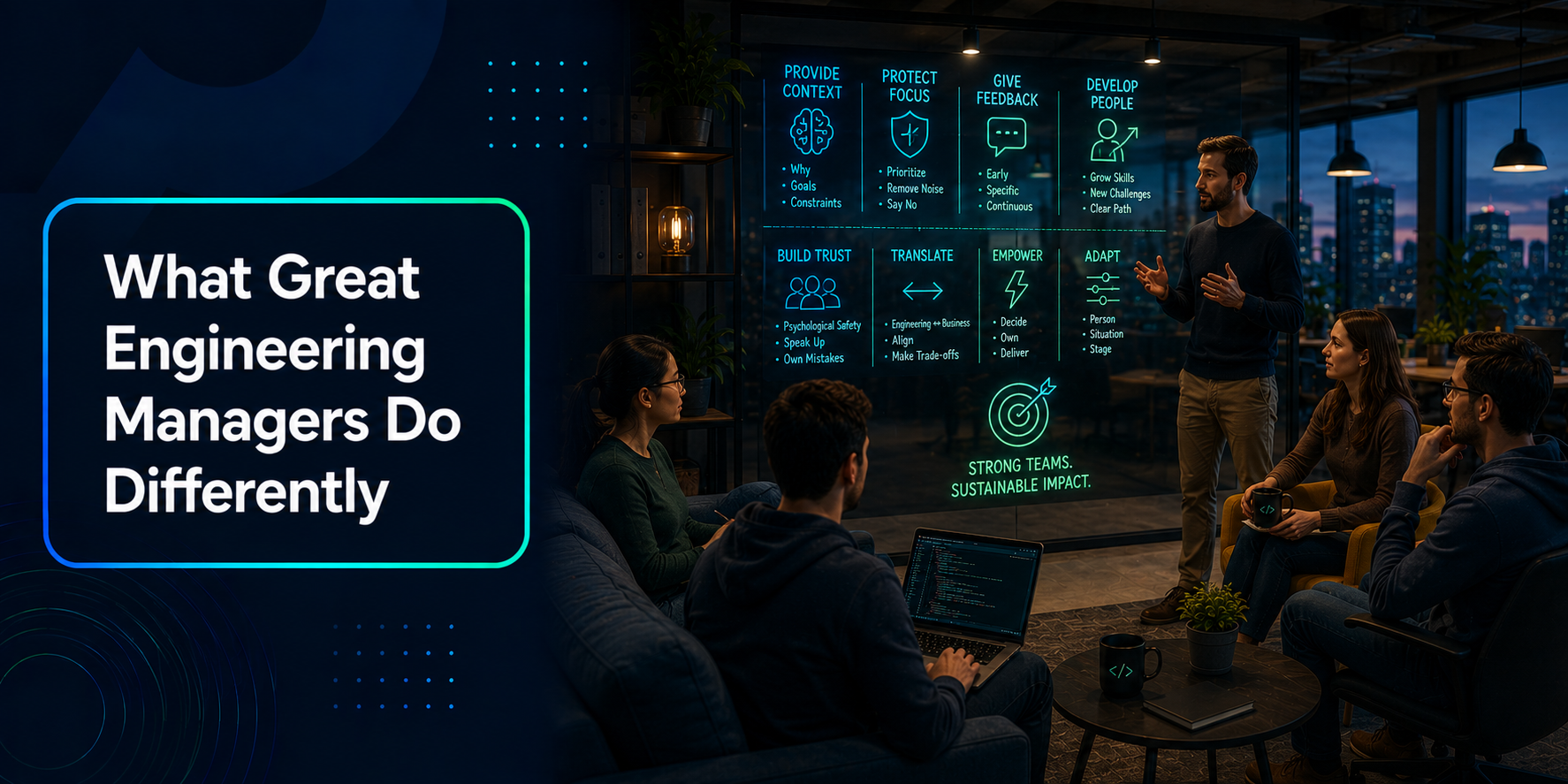
- They Provide Context, Not Control
Great engineering managers don’t need to dictate every implementation decision. Instead, they make sure the team understands the problem well enough to make good decisions independently. There is an important difference between telling an engineer:
“Build this feature exactly this way by Friday.”
and explaining:
“Customers are abandoning this process because it takes too long. We need to reduce that friction, and here are the business and technical constraints we’re working within.”
The second gives the engineer something much more valuable than instructions: context. Software development is full of situations that weren’t anticipated when the original task was written. Requirements change. Edge cases appear. Technical limitations emerge. Production behaves differently from staging. If engineers understand only what they were asked to build, every unexpected situation has to travel back up the management chain for another decision. If they understand why they are building it, they can make sensible decisions themselves.
That is one of the clearest differences between control and leadership. Control creates dependency. Context creates autonomy.
- They Protect Focus Without Creating Isolation
Engineering work requires concentration. Yet many developers operate in environments where their attention is fragmented across Slack messages, meetings, stakeholder requests, urgent tickets, changing priorities, and constant questions about when something will be finished.
A great manager understands that protecting focus is part of the job. That doesn’t mean creating a wall between engineers and the rest of the business. Engineers still need exposure to customers, product thinking, and commercial realities. The manager’s role is to make that interaction intentional rather than chaotic.
When five stakeholders arrive with five “urgent” requests, someone needs to establish which one is actually urgent. When priorities change, someone needs to explain what is changing and what should consequently stop. When scope expands halfway through a project, someone needs to make the trade-off visible rather than quietly expecting the team to absorb additional work. Great managers act as a filter for organizational noise. They don’t protect engineers from the business. They protect engineers from unstructured business pressure.
- They Give Feedback Before It Becomes a Problem
One of the easiest ways to identify a weak management culture is to look at when employees receive meaningful feedback. If the answer is “during the annual performance review,” it is probably too late. Great managers don’t allow feedback to accumulate for six or twelve months. They have smaller conversations earlier.
They tell someone when their technical work is excellent but their communication is making collaboration difficult. They recognize when an engineer is ready for more responsibility. They notice when someone is repeatedly struggling with the same type of problem and help them understand what needs to change. Just as importantly, feedback isn’t only corrective. People need to know what they are doing well so they can intentionally repeat it.
A strong manager might say:
“The way you handled that production incident was excellent. You stayed calm, communicated clearly, and helped two junior engineers understand the problem instead of simply fixing it yourself. That’s exactly the kind of behaviour we’d expect at the next level.”
That is much more useful than “Great job.” Specific feedback turns everyday work into professional development.
- They Treat Career Growth as Ongoing Work
One of the recurring frustrations we hear from candidates considering a job change is some version of: “I don’t see where I can go from here.” Sometimes the company has career frameworks and promotion processes on paper. What is missing is someone actively helping the employee navigate them.
Great engineering managers understand what their people want to become. Not everyone wants the same thing. One engineer may want to move toward architecture. Another may want deeper technical specialization. Someone else may want their first opportunity to mentor people or lead a project. Another may be perfectly happy remaining an individual contributor but wants more complex technical challenges.
Good managers don’t force everyone onto the same ladder. Instead, they look for opportunities inside real business work that help people develop. They might give an engineer ownership of a technical initiative, involve someone in architecture discussions, create mentoring opportunities, or deliberately rotate responsibilities so that one person doesn’t become permanently trapped maintaining the same legacy system simply because they happen to know it best. Career development isn’t something that happens outside the work. Done well, it is built into the work itself.
- They Know When Not to Intervene
This may be one of the hardest management skills to develop. Many managers reach their position because they were excellent problem-solvers. When they see a problem, their instinct is naturally to solve it. But leadership often requires resisting that instinct.
If a senior engineer encounters a difficult technical decision, the fastest solution may be for the manager to step in and provide the answer. The better long-term solution may be to ask:
- “What options are you considering?”
- “What trade-offs do you see?”
- “What would you choose if this decision were entirely yours?”
The goal isn’t to withhold support. It is to avoid becoming the bottleneck through which every important decision must pass. Great managers know when the team needs direction, when someone needs coaching, and when the best thing they can do is get out of the way.
- They Make Psychological Safety Practical
Psychological safety can sound like a soft management concept until you see what its absence costs an engineering organization. If developers are afraid to admit uncertainty, technical risks remain hidden. If junior engineers are afraid to ask questions, mistakes become more expensive. If people believe challenging a senior decision will damage their reputation, bad ideas survive longer than they should. If admitting a production mistake leads immediately to blame, the next mistake may be hidden. Great engineering managers create an environment where people can say:
“I don’t know.”
“I think we made the wrong decision.”
“I need help.”
“I broke something.”
without assuming that doing so will be used against them.
This doesn’t mean lowering standards or removing accountability. In fact, psychologically safe teams can often maintain higher standards, because problems become visible earlier and can actually be addressed.
- They Translate Between Engineering and the Business
One of the most valuable skills in an engineering manager isn’t purely technical. It is translation. Leadership may say:
“We need this launched next month.”
Engineering may say:
“That isn’t technically realistic.”
A weak manager simply carries one message to the other side. A strong manager explores what is behind both statements. Why does the business need next month? Is there a customer commitment, revenue opportunity, regulatory deadline, or competitive reason? Why does engineering need more time? Is the problem scope, architecture, testing, security, dependencies, or capacity? Once those realities are understood, trade-offs become possible.
Perhaps the first version can be smaller. Perhaps another initiative can pause. Perhaps additional technical risk is acceptable temporarily – provided everyone understands what that risk actually means. Great engineering managers don’t merely communicate between technical and non-technical stakeholders. They help both sides understand each other well enough to make better decisions.
- They Adapt Their Management Style to the Person
There is no universally perfect management style. A junior developer in their first production environment may need regular guidance, clear expectations, and frequent feedback. A senior engineer who has spent fifteen years designing distributed systems probably doesn’t need someone checking their Jira tickets twice a day. Managing both people identically isn’t fairness. It is poor management.
Great managers adjust the level of direction, autonomy, feedback, and support according to the person’s experience, confidence, performance, and current situation. And that balance can change. Someone who needs close support today may need significant autonomy six months from now. Someone normally highly independent may temporarily need more help during a difficult project or transition. Leadership requires paying enough attention to notice the difference.
The Ultimate Force Multiplier
The paradox of great engineering management is that the better managers become, the less dependent the team becomes on them. They don’t measure their value by how many decisions require their approval or how many meetings they attend.
They look at whether people understand the priorities. Whether engineers can make decisions independently. Whether problems surface early. Whether knowledge is shared rather than concentrated in one person. Whether people are developing. Whether the team can deliver without permanent urgency. And whether strong employees actually want to stay.
The ultimate test of a great engineering manager might be surprisingly simple: What happens when they aren’t there? If the team immediately stops, waits for decisions, and loses direction, the manager may have created dependency. If the team continues operating confidently because priorities, ownership, trust, and decision-making are already embedded in how people work, the manager has created something much more valuable. They have built capability.
What This Means When Hiring Engineering Managers
This distinction matters enormously in recruitment. When assessing engineering managers, companies naturally look at previous team size, technical background, years of leadership experience, delivery history, and familiarity with the technology stack. Those things matter. But they don’t tell the whole story. We also need to understand what happened to the people around them.
- Did engineers become more independent?
- Did people progress into larger roles?
- How did the manager respond when someone struggled?
- Could they challenge unrealistic expectations from senior stakeholders?
- Did they create clarity during periods of change?
- Were they able to retain strong people – and when someone left, did they understand why?
The best management candidates don’t simply have stories about projects they successfully delivered. They have stories about people and teams that became stronger because they were there. Technology will continue automating more of the administrative side of management. Status updates, reporting, scheduling, documentation, and project tracking will become increasingly efficient. That doesn’t make engineering managers less important. It makes the genuinely human parts of their job more visible. Because great engineering management was never really about managing Jira. It is about creating an environment where talented people have the context, trust, protection, and opportunity to do exceptional work.